
Why Do We Like Tragedies?
A Review of Oedipus the King

I’ve always been intimidated by ancient literature. Until recently, I believed Aeschylus or Sophocles are best read in school. I believed they’re literature intended for cultural or historical academics for papers and journals. But then I opened The Oresteia out of curiosity and I realized I’ve been blinded by my ignorant assumption. These tragic plays are not served for a particular interest but are great for anybody. I found “tragic pleasure” to be their selling point serving the purest form of drama in literature.
Why do we find tragedies so fascinating? Here, I review Sophocles’ Oedipus the King, one of the most popular tragedies of all.
The Writer
Born to a wealthy family in 496 BC in Colonus, Sophocles was one of the three great tragic playwrights of classical Athens. He was highly educated and heavily involved in politics and military affairs. He wrote 123 dramas for dramatic festivals and picked up more than 20 victories. Only seven of his works survive today: Ajax, Electra, The Trachinian Women, Philoctetes, Antigone, Oedipus at Colonus, and Oedipus the King, the last three more commonly known as The Theban Plays.
Sophocles went on to be successful and lived a long and impactful life. Critics have called him the lesser of the other two playwrights—Aeschylus and Euripides—but “The Master Dramatist” continues to be read and performed today.
The Cover
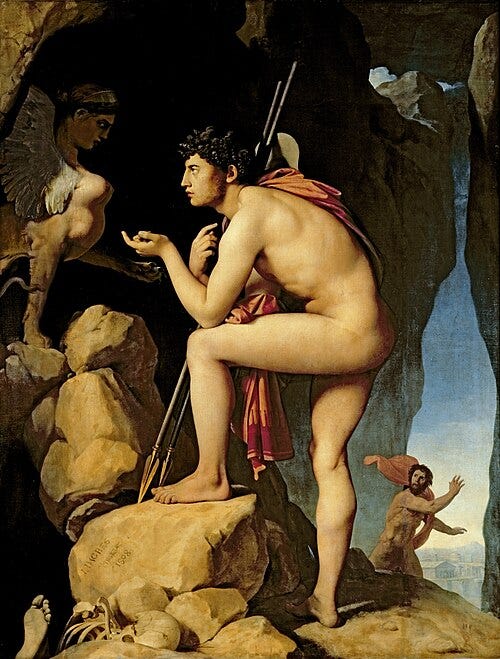
Oedipus the King is one of the plays featured in Sophocles I published in 19911. My copy has Oedipus and the Sphinx on the cover, a painting by the French Neoclassical artist Jean-Auguste-Dominique Ingres. Painted in 1808, it shows Oedipus explaining the riddle of the Sphinx.
The Sphinx is in lines 35-41 in the book:
You came and by your coming saved our city,
Freed us from tribute which we paid of old
To the Sphinx, cruel singer. This you did
In virtue of no knowledge we could give you,
In virtue of no teaching; it was God
That aided you, men say, and you are held
With God’s assistance to have saved our lives.
Sophocles introduces Oedipus, a beloved king who is seen as a divinely ordained hero of his city. He is seen on the cover answering a riddle that has puzzled many before him. Oedipus sounds noble, trustworthy and smart, a man who understands the responsibilities that accompany his role as king. He's the kind of man people root for.
And then we learn of the horror of his life. While many are familiar with Oedipus’ story through Freud’s Oedipal Complex theory, it’s the dramatic irony of Oedipus’ eventual realization of his crime that makes the book rich.
The Style
Following the writing style of a Greek tragedy, Oedipus the King is formal, elevated, and poetic. Words are lofty and noble. There’s plenty of metaphors, and there are ‘choral odes’—choruses meant to be sung as a form of commentary. Written to be performed and not just read, these elements reflect the book’s serious theme.
While poetry may not be everyone’s cup of tea, I encourage anyone to give it a try. It grows on you with every reading. There’s something delightful and clean about its form. There’s movement and sound. The reading experience is close to the thrill in seeing live music rather than listening to a recording in the car.
The Premise
Oedipus the King opens in front of the palace at Thebes where the priest with a crowd of children seek Oedipus’ help for answers. The city is suffering from a terrible plague and its citizens are desperate. Since Oedipus once saved the city by solving the riddle of the Sphinx, he’s the most likely to do it again.
Oedipus tells them, “know that I have given many tears to this,”—he sent Creon, his brother-in-law, to consult the Oracle of Apollo to find an answer. Creon then returns with the message: The plague will end only when the murderer of the former king, Laius, is found and punished. Oedipus vows to uncover the truth and curses the unknown killer:.
“Since I am now the holder of his office,
And have his bed and wife that once was his…
I fight in his defence as for my father,
And I shall try all means to take the murderer
Of Laius the son of Labdacus…
Those who do not obey me, may the Gods
Grant no crops springing from the ground they plough
Nor children to their women!.....”
Oedipus curses the murderer, not realizing he’s cursing himself. This scene then begins a series of truly unfortunate events. Oedipus realizes that it was him who killed Laius, his father, and that his wife Jocasta, is actually his mother. (!)
Jocasta (a great name btw), hangs herself after learning the news:
And then she groaned and cursed the bed in which
She brought forth husband by her husband, children
By her own child, an infamous double bond.
Oedipus, tears the brooches of his mother’s robe and dashes them on his own eyeballs, shrieking,
They will never see the crime
I have committed or had done upon me!
I gasped. My jaw dropped. Maybe I’m starved of this kind of drama but I was incredibly impressed at how deeply I felt each verse’s rage, awe, and grief.
The Big Idea
Oedipus the King asks big questions. Existential ones that question the purpose of suffering, of fate, and its relationship with free will. It offers no concrete answers as to why humans suffer but it shows suffering’s indiscriminate regard to man’s moral standing. The reversal of Oedipus’ fate, from hero to a blind beggar, presents a great tragedy that affects the audience’s empathy and appreciation for human resilience and spiritual processing. Only when we are on the other side of tragedy do we begin to understand life with good spiritual wisdom and a deeper understanding of human flourishing.
Oscar Wilde writes in The Picture of Dorian Gray2:
It often happens that the real tragedies of life occur in such an inartistic manner that they hurt us by their crude violence, their absolute incoherence, their absurd want of meaning, their entire lack of style. They affect us just as vulgarity affects us. They give us an impression of sheer brute force, and we revolt against that. Sometimes, however, a tragedy that possesses artistic elements of beauty crosses our lives. If these elements of beauty are real, the whole thing simply appeals to our sense of dramatic effect. Suddenly we find that we are no longer the actors, but the spectators of the play. Or rather we are both. We watch ourselves, and the mere wonder of the spectacle enthralls us.
Becoming both the spectator and the actor of life explains to me the pleasure in reading Sophocles and his plays. It’s an education for life. There’s beauty in its style. Tragedy gives proof of life and it’s folly to assume a life long lived is free from it.
Sophocles, Sophocles I: Oedipus the King, Oedipus at Colonus, Antigone, trans. David Grene and Richmond Lattimore (Chicago: University of Chicago Press, 1991).
Oscar Wilde, The Picture of Dorian Gray, ed. Joseph Pearce (San Francisco: Ignatius Press, 2008), 106.